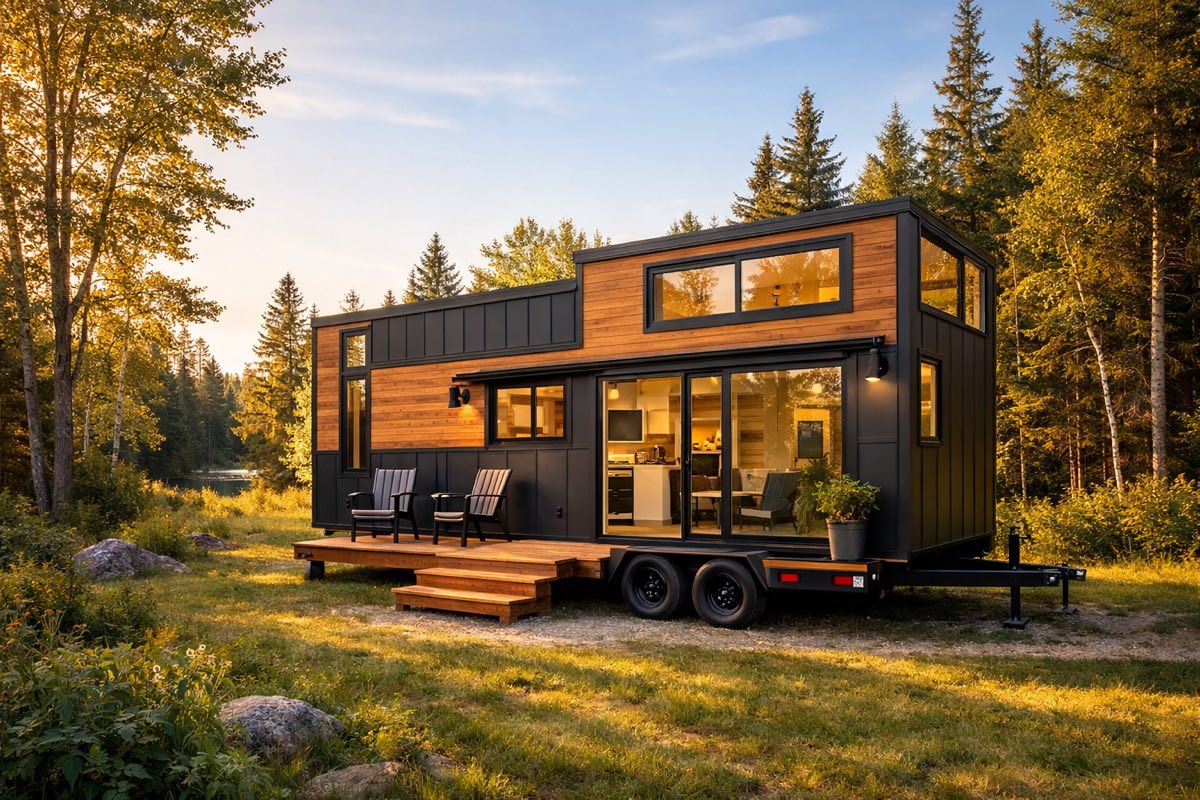
A tiny house trailer is a purpose-built foundation designed to support residential construction while withstanding the unique stresses of highway towing, frequent loading and unloading, and extended stationary use. Unlike standard utility trailers, these specialized frames form the literal foundation of your home—making proper selection critical for transport safety, legal compliance, and long-term durability of your investment.
- Deck-over trailers provide unobstructed floor space but raise overall height, making them the preferred choice for most tiny house builders
- Fender-style trailers offer better ground clearance and lower profile, but require notching into floor systems that can create structural and water intrusion concerns
- The running gear system (axles, suspension, hubs, wheels) bears your entire load while moving and must handle dynamic towing forces
- Trailer selection directly impacts state registration requirements and legal compliance for your tiny house
- Frame construction quality determines how well your trailer holds up under road travel demands over time
Tiny House Trailer: Your Complete Guide to Selection, Specifications, and Regulations
Your tiny house trailer is not an afterthought. It is the foundation upon which your entire project rests, quite literally. The decisions you make during trailer selection will determine how safely you can transport your home, whether your structure meets legal requirements, and how long your investment holds up under the demands of road travel.
This guide covers everything you need to know about tiny house trailers: from frame construction and weight specifications to state registration requirements and towing safety. Whether you are just beginning to explore the tiny house movement or are ready to purchase your trailer, this article provides the technical foundation for making confident decisions.
Understanding Tiny House Trailer Basics
Tiny house trailers differ significantly from standard utility trailers. They are purpose-built structures designed to support residential construction while withstanding the unique stresses of highway towing, frequent loading and unloading, and extended periods of stationary use.
Trailer Types: Deck-Over vs. Fender-Style
The first major decision involves choosing between two primary trailer configurations.
Deck-over trailers feature a continuous flat deck that extends over the wheels. This design eliminates wheel wells from the trailer bed, creating an unobstructed surface for construction. The wheels mount beneath the deck frame, which raises the overall height of your house slightly but provides maximum interior floor space. Deck-over trailers have become the preferred choice for most tiny house builders because they simplify floor joist installation and provide cleaner structural lines.
Suggested read: Tiny House Kit Homes
Fender-style trailers position the wheels below deck level, with the wheels and their housings visible on either side. These trailers offer better ground clearance and a lower overall profile, which may matter if you face height restrictions. However, the wheel wells require notching into your floor system, creating potential structural complications and water intrusion points that demand careful sealing.
Key Components Overview
Every tiny house trailer consists of several integrated systems that must work together reliably.
The running gear includes the axle assembly, suspension system, hub assemblies, and wheels. This system bears your entire load while moving and must handle the dynamic forces of towing. Quality running gear components are non-negotiable for safety.
The coupler connects your trailer to your tow vehicle’s hitch. Trailer hitches come in several sizes, with 2-inch and 2-5/16-inch couplers being most common for tiny house applications. Your tow vehicle’s hitch capacity must exceed your trailer’s tongue weight.
Trailer decking forms the floor base for your house construction. Common materials include pressure-treated plywood, composite decking, or steel. The decking must handle both static loads from your structure and dynamic loads from towing stress.
Technical Specifications and Requirements
Getting the technical specifications right prevents costly mistakes. The numbers matter enormously in tiny house building.
Dimensions and Sizing
Most tiny houses fall within specific dimensional limits to remain road-legal across most jurisdictions. Standard width is 8.5 feet, and height typically maxes out at 13.5 feet when measured from ground to roof peak. Length limits vary by state but generally range from 40 to 45 feet total, including the trailer.
Common trailer lengths include 16-foot, 20-foot, and 24-foot options. A 20-foot trailer provides approximately 170 square feet of living space, which suits most single-occupancy or couple living arrangements. Longer trailers increase space but place greater demands on your tow vehicle and reduce maneuverability.
Understanding Weight Capacity
Gross Vehicle Weight Rating (GVWR) represents the maximum loaded weight your trailer can safely carry, including the trailer’s own weight. For tiny houses, trailers typically range from 5,000 to 14,000 pounds GVWR.
Your payload capacity is the GVWR minus the empty trailer weight. A trailer rated for 10,000 pounds that weighs 2,500 pounds empty offers 7,500 pounds of payload capacity for your house, fixtures, and belongings.
Tongue weight—the downward force the trailer exerts on the hitch—should fall between 10% and 15% of your total loaded weight. Insufficient tongue weight causes trailer sway, while excessive tongue weight overburdens your tow vehicle’s rear axle.
Always select a trailer with GVWR exceeding your projected house weight by at least 20%. This buffer accommodates unexpected loads from water tanks, occupant belongings, and construction miscalculations.
Frame Construction: I-Beam vs. C-Channel
The frame structure determines your trailer’s strength, durability, and weight characteristics.
I-beam frames use steel beams shaped like the letter “I” as the primary structural members. This design provides superior strength-to-weight ratio, meaning you get more load-carrying capacity without excessive trailer weight. I-beam construction has become the industry standard for quality tiny house trailers.
Suggested read: Tiny House Shed
C-channel frames use C-shaped steel rails. While less expensive to manufacture, C-channel frames typically require additional reinforcement to match the strength of I-beam construction. Budget trailers often feature C-channel frames that may not adequately support long-term tiny house use.
Frame material quality matters as much as design. Look for trailers using hot-dipped galvanized steel or properly treated structural steel that resists rust in wet climates.
Axles, Suspension, and Running Gear
The axle assembly handles your load’s weight while moving. Most tiny house trailers use torsion axles or leaf spring suspensions, each with distinct characteristics.
Torsion axles use rubber cords within the axle tube to provide suspension. They offer a smoother ride, lower maintenance requirements, and better ground clearance adjustment options. Many builders prefer torsion axles for tiny house applications.
Leaf spring suspensions use layered steel strips to absorb road shock. They are simpler to repair and generally less expensive but add unsprung weight and may require more maintenance over time.
Quality hub assemblies with appropriate bearing sizes ensure reliable wheel performance. Inadequate hub quality leads to premature failure and dangerous wheel-off scenarios.
Regulatory and Legal Requirements
Navigating regulations represents one of the most challenging aspects of tiny house ownership. Requirements vary dramatically by jurisdiction.
RVIA Certification
The Recreational Vehicle Industry Association (RVIA) certification indicates that a manufactured unit meets established safety standards for recreational vehicles. RVIA certification becomes necessary if you plan to camp in RV parks, sell your home as a certified unit, or obtain certain types of insurance coverage.
For custom-built tiny houses, obtaining RVIA certification requires inspection by RVIA representatives and compliance with their construction standards. While not required for private owner-built units in most jurisdictions, certification provides credibility and ensures your build meets recognized safety benchmarks.
State DMV Registration
Tiny house trailers generally require registration as utility trailers or house trailers in most states. Fees, titling requirements, and inspection requirements vary by state. Some states classify tiny house trailers as recreational vehicles, while others treat them as utility trailers.
Several states have enacted specific tiny house legislation addressing dimensions, construction standards, and permitted locations. California, Oregon, Colorado, and Maine have notably developed more detailed frameworks supporting tiny house on wheels development.
Check your state DMV website for current requirements, as regulations evolve rapidly in this space. Budget for registration fees ranging from $50 to several hundred dollars depending on your state.
Towing Regulations
Federal regulations establish baseline requirements for trailers over 3,000 pounds GVWR, including braking requirements. Trailers exceeding 4,500 pounds GVWR generally require trailer brakes that activate in coordination with your tow vehicle’s braking system.
Suggested read: Tiny Bugs in House: A Complete Guide to Identification and Control
Brake controllers installed in your tow vehicle regulate trailer braking force. Electric brake controllers offer adjustable settings to match your cargo and road conditions. Proper brake controller setup is essential for safe towing.
Lighting requirements include brake lights, turn signals, tail lights, and clearance markers. Your trailer must have a functioning electrical connection to your tow vehicle that activates all required lights.
Cost Considerations and Budget Planning
Understanding true cost of ownership prevents unpleasant surprises during your build.
New Trailer Pricing
Quality tiny house trailers typically range from $5,000 to $12,000 depending on specifications. Entry-level trailers with adequate capacity for lightweight builds start around $5,000 to $7,000. Premium trailers featuring I-beam construction, torsion axles, and enhanced corrosion protection command $9,000 to $12,000 or higher.
Custom modifications—extended lengths, enhanced payload ratings, integrated battery boxes, or utility hookup packages—add to base prices but may prove more economical than aftermarket modifications.
Used Trailer Considerations
Used trailers can offer significant savings but require careful evaluation. Inspect for structural damage, rust that compromises frame integrity, axle wear, previous accident history, and signs of water damage to decking. A thorough inspection by a qualified trailer mechanic costs $100 to $200 but can reveal problems that would cost thousands to repair.
Budget trailers under $4,000 often represent false economy. Substandard materials, inadequate welds, and insufficient engineering create safety risks and may void your homeowner’s insurance coverage.
Hidden Costs
Beyond the purchase price, budget for delivery fees ($1 to $3 per mile in many regions), registration costs, potential brake controller installation ($100 to $300 if not already equipped), and wiring harness modifications if your tow vehicle lacks compatible connections.
Choosing the Right Trailer for Your Project
Match your trailer specifications to your specific house design and intended use.
Assessment Framework
Start by calculating your expected finished weight. Include your structure, all finishing materials, appliances, fixtures, water in tanks, and estimated occupant belongings. Add a 20% safety margin, then select a trailer with GVWR exceeding that figure.
Consider your destinations. If you plan to travel frequently, a lighter trailer with superior fuel economy may matter. If your tiny house will remain stationary for extended periods, slightly different specifications might suit your needs.
Verify your tow vehicle’s capacity matches your loaded trailer weight. Never exceed your vehicle’s towing rating, and maintain comfortable margins for mountain driving and emergency situations.
Quality Indicators
Quality trailer manufacturers provide detailed specifications, offer warranties, and demonstrate transparent engineering. Look for full welds rather than spot welds in critical structural areas, properly sealed bearing systems, and adequate cross-member spacing for your intended floor joist configuration.
Suggested read: Tiny House Decor: The Complete Guide for RV Owners
Reputable manufacturers such as those producing Tumbleweed and Escape models have established track records and provide documentation supporting their engineering claims.
Safety and Towing Considerations
Safe towing requires understanding weight distribution and proper equipment.
Weight Distribution Principles
Load your tiny house with heavier items positioned over the axle locations, not at the front or rear extremes. Front-heavy loads increase tongue weight beyond safe limits, while rear-heavy loads can cause dangerous sway at highway speeds.
Your wheelbase—the distance between your trailer’s axle centers—affects towing stability. Longer wheelbases generally provide more stable handling but require more space for turning.
Pre-Tow Inspection Checklist
Before every trip, verify tire pressure and condition, check that all lights function correctly, confirm wheel bearings are properly lubricated, verify coupler security and safety chain connections, and confirm that your brake controller activates trailer brakes appropriately.
Ongoing Maintenance
Monthly: inspect wheel bearings for play and repack as needed. Annually: comprehensive brake inspection, suspension component check, frame inspection for developing cracks or rust, and electrical system verification. Regular maintenance prevents failures and extends trailer lifespan significantly.
Frequently Asked Questions
What is the difference between a deck-over and fender-style tiny house trailer?
Deck-over trailers have the deck surface extending over the wheels, providing an unobstructed construction surface. Fender-style trailers position wheels below deck level, offering better ground clearance but requiring notched wheel wells in your floor system.
How much weight can a tiny house trailer support?
Weight capacity varies by design, typically ranging from 5,000 to 14,000 pounds GVWR. Select a trailer with capacity exceeding your projected finished weight by at least 20% to ensure safety and accommodate unexpected loads.
Do I need RVIA certification for my tiny house on wheels?
RVIA certification is not legally required for private builds but becomes necessary for camping in RV parks, obtaining certain insurance coverage, or selling your home as a certified unit. It verifies that your build meets recognized safety standards.
What is the average cost of a quality tiny house trailer?
Quality tiny house trailers typically range from $5,000 to $12,000 depending on capacity, features, and manufacturer. Budget options under $4,000 often lack structural integrity needed for safe, long-term tiny house use.
How do I determine the correct trailer size for my tiny house?
Consider your state’s length limits, your tow vehicle’s capacity, your mobility needs, and your living space requirements. Most tiny houses use 8×20 or 8×24 foot trailers. Calculate your expected finished weight and select a trailer with appropriate GVWR.
Should I buy a new or used tiny house trailer?
New trailers provide warranty coverage, known history, and customization options. Used trailers offer savings but require thorough inspection for structural damage, rust, axle wear, and previous accident history. For safety-critical applications, new trailers are often preferred.
What frame type is best for a tiny house trailer?
I-beam frames offer superior strength-to-weight ratio and are preferred for most tiny house applications. C-channel frames are common in budget trailers but may require additional reinforcement for equivalent load capacity.
What maintenance does a tiny house trailer require?
Monthly: wheel bearing inspection and repacking. Annually: brake inspection, rust prevention, lubrication of moving parts, and verification of welds, decking, and lighting systems. Consistent maintenance ensures long-term safety and reliability.
Suggested read: The Best Tiny House Vendors References
Conclusion
Your tiny house trailer forms the literal foundation of your project. Technical specifications matter enormously—frame construction type, weight capacity, dimensions, and component quality all affect your ability to transport your home safely and legally.
Key decision points: Select a trailer with GVWR exceeding your expected loaded weight by at least 20%. Choose I-beam frame construction for superior strength. Decide between deck-over and fender configurations based on your construction preferences and clearance requirements. Verify that your tow vehicle can safely handle your loaded trailer.
Budget realistically, including hidden costs for delivery, registration, and potential equipment upgrades. Investigate your specific state regulations before purchasing, as registration and titling requirements vary significantly.
If you are beginning your research, start by determining your expected finished weight, then identify trailers meeting those specifications from reputable manufacturers. Request detailed specifications and warranty information before making purchase decisions.
The right trailer choice sets your tiny house project up for success. Take time with this decision, verify specifications carefully, and prioritize quality and safety over cost savings.